
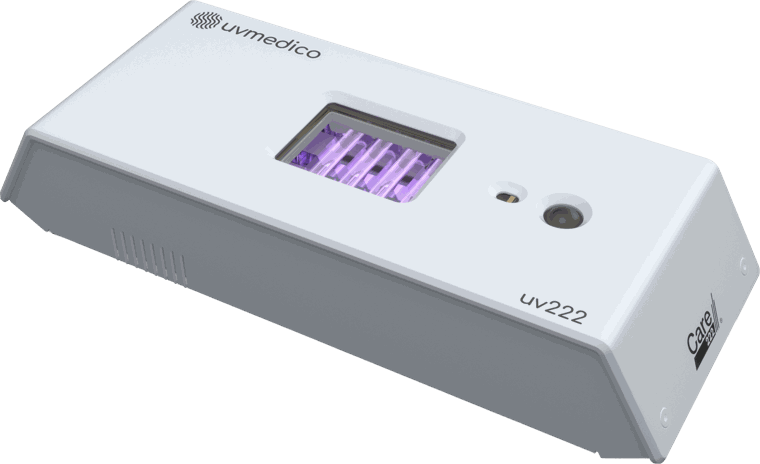
Ask a supplier what their far-UVC lamp "does" and you will be given a number in microwatts per square centimetre. Ask what that number means and the conversation usually ends. It is worth having, because there are two different quantities hiding behind the same unit, and which one you are looking at changes what you can promise a room.
Two quantities, one unit
Irradiance is what a flat surface receives. It has a direction: the surface faces somewhere, and light arriving at an angle is spread over a larger area, so the reading falls with the cosine of the angle. At 60° from the normal it is exactly half. Irradiance is the right quantity for the dose on a bench, a floor or a piece of equipment — and for eye and skin exposure, which is why every safety limit is written in it.
Fluence rate is what a point in space receives from every direction at once. Picture a tiny sphere: light hits it from the lamp, from the walls, from the ceiling, from the floor, and all of it counts. A bacterium suspended in the air is that sphere. So is an oxygen molecule about to be split into ozone. Fluence rate has no direction and no cosine; it is the quantity that governs air disinfection and every photochemical reaction in the room.
Both are written in W/m² or µW/cm². Holger Claus, one of the co-authors of the standard germicidal-UV literature, published a perspective in Photochemistry and Photobiology this year whose first job is to say plainly that the two are used interchangeably in the far-UVC field and should not be.
Claus, 2026
Why the meter lies in a real room
The hand-held radiometer every installer carries reads irradiance. It equals fluence rate in exactly one situation: pointed straight at a single lamp, square on, with nothing reflecting. Put a second lamp in the room, or a white ceiling, and the reading understates what the air is actually receiving. In a reflective space the gap can be large — Claus notes that inside an integrating sphere the fluence rate is four times the irradiance measured at the wall.
This is the reason a survey with one meter and no model is not a survey. The number you need for the air cannot be measured practically at the several hundred points a room would require; it has to be calculated, and then checked at a few points where the geometry is simple.
How we arrive at it
Three steps, in this order. First, a path-length estimate: if the ceiling of area A radiated power P downwards, the mean fluence rate would be P/A. It gives the theoretical ceiling and tells us roughly how many lamps a room needs. Second, a radiosity simulation in Illuminate, which is built for germicidal UV and accounts for wall reflections — in the paper's own example, moving the same two lamps to a diagonal raised the mean fluence rate by 50%. Position is not a detail. Third, point measurements on site, taken directly under the lamp and at one to two metres, where the result depends least on exactly where the sensor sits.
One room, both answers
Here is why this matters beyond tidiness. Pathogen inactivation and ozone formation are driven by the same fluence rate, so once you have the number, you get both predictions from it — one equation each. The paper's worked example is a 4 × 3 × 3 m room, 36 m³, with two filtered krypton-chloride lamps giving a mean fluence rate of 1.8 µW/cm² — squarely inside the ordinary commercial range. At steady state that is a 94.5% reduction in a representative airborne virus, equivalent to 25.9 extra air changes an hour — and an ozone increase of 5.4 ppb, against the WHO eight-hour guideline of about 50.
Both numbers come from the same photons. Which means a claim of "near-total pathogen elimination with zero ozone" is not a marketing exaggeration. It is physically impossible, and anyone making it has either not measured or is hoping you will not ask.
What this changes in your site study
We design to fluence rate, not to lamp output. Two identical lamps in different positions give different rooms. The study you receive from us states the mean fluence rate we are designing to, the model it came from, the predicted reduction for the organisms you care about, and the predicted ozone increase for your room's ventilation and furnishing — all from the same figure. Then we go and measure it.
One thing we watch on your behalf: there is an active proposal to tighten the ozone guideline from 50 ppb towards 5. If it lands, it changes how aggressively any far-UVC installation can be sized, ours included. We would rather you heard that from us now.